


Modular testbed for evaluating soft robot's controllers
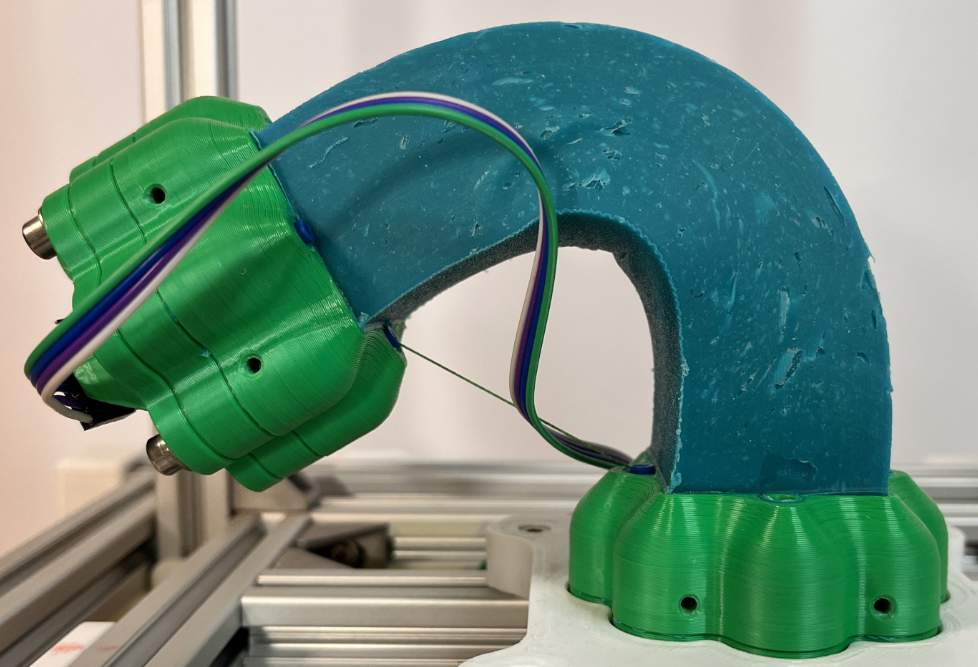
Alongside the advancements in soft robot technology, there is also a need for a standardized hardware platform that can enable benchmarking of various control methods developed for soft-bodied robots. This modular testbed contributes to the state-of-the-art by allowing the researchers to evaluate their control methods on standardized and open-source platform that that features exemplary tendon-driven soft-bodied robots with integrated closed-loop tip position and tendon position and force control.
| Name of Principal Investigator: | Maja Trumić |
| Position / institutional role: | Research Associate |
| Info Email: | maja.trumic@etf.rs |
| ORCID persistent identifier (PID): | 0000-0002-2945-8010 |
| Name of Host Organization | University of Belgrade – School of Electrical Engineering (ETF) |
| Department or Lab | Department of Signals and Systems, ETF Robotics lab |
| Name of Building | Palace of Science |
| Physical Address | Kralja Milana 11, 11000 Beograd, Serbia |
| Website Links | https://robot.etf.bg.ac.rs |
| Institutional contact name | Prof. Kosta Jovanović |
| Institutional contact email | kostaj@etf.rs |
| Non-academic stakeholders |
| Startups; SMEs |
| Academic stakeholders |
| Undergraduate students; PhD students; MSc students; Researchers |
| Other types of stakeholders |
| Application case: | Short description: |
| Benchmarking soft-robot control methods | The TestBed is intended as a reproducible hardware platform for comparing control methods for tendon-driven soft continuum robots, including model-based and learning-based approaches. |
| Education and student projects | Suitable for teaching mechatronics, embedded systems, soft robotics, CAD, PCB design, sensor calibration, control engineering and experimental data analysis. |
| SME/startup support and rapid prototyping | The TestBed can support early proof-of-concept work for compliant manipulators, soft grippers, safe human-robot interaction devices and low-cost robotic actuation modules. |
list of hardware components with their brief descriptions:
Modular soft-robot TestBed frame — 20×20 mm aluminium extrusion frame with stationary base, movable frame, base plate, hinges/locking profiles, T-nuts and M4 screws. The central part can be adjusted from 0° to 90° to support tests with upright or highly elastic soft bodies.
Soft continuum robot bodies — Silicone-based continuum bodies for tendon-driven soft robotics experiments. Supports cylindrical, cuboid and other rod-like shapes; supports internal and external tendon routing. Mold Max 30 silicone, Shore hardness 30A, is used in the documented version.
Universal lower and upper plates — 3D-printed PLA plates used as the mechanical interface between the frame, silicone body and tendons. Plate design includes anchoring points, button-head screws, coned screws and PTFE tendon guides.
Plate holder and tendon-routing hardware — Pneumatic adapters and PTFE guide tubes used to guide tendons with low friction, protect tendons from wear and enable quick tendon replacement.
Modular casting molds — Mold systems for internally and externally routed tendons. Internal routing uses a thin-walled metal pipe with 50 mm inner diameter and 3D-printed holders; tendon channels are formed using 2 mm wires. External routing uses a reusable fully 3D-printed mold.
Custom tendon actuator modules — 3D-printable actuator units with actuator mount, motor mount, tendon spool, integrated load cell, motor driver electronics and instrumentation amplifier. Designed for standalone use or multi-actuator daisy-chained setups.
Brushed DC motors — Documented setup uses 12 V Pololu 19:1 geared brushed DC motors; electronics support 8–28 V operation and up to 5 A motor current, enabling 12 V and 24 V brushed DC motor variants. Only the motor-mount part needs redesign for alternative motors.
Custom actuator PCB — 4-layer PCB with Raspberry Pi Pico microcontroller, DRV8842 motor driver, INA826 instrumentation amplifier, I2C connectors, power connectors, motor connector and 5 A fuse.
Force sensing and calibration equipment — Load cell integrated into each actuator for direct tendon-force feedback; calibration stand with reference/calibrated load cell, tensioner and spring for mapping amplifier voltage to force.
IMU sensor — MPU6050 IMU mounted at the robot tip in documented experiments for measuring pitch/roll angle and evaluating tip-orientation tracking.
Power and communication equipment — USB connection for single-actuator control, I2C bus for multi-actuator daisy chaining, serial interface to a PC, and external DC power supply suitable for the selected motor voltage/current.
Other recommended safety hardware — Current-limited bench power supply, emergency stop or master power cutoff, physical tendon/rotating-spool guards, PPE for silicone handling, and clearly marked operating area.
list of software components with their brief descriptions:
Actuator firmware — C firmware running on Raspberry Pi Pico for low-level motor control, load-cell reading and PI force control.
Soft Robot Controller firmware — Raspberry Pi Pico controller acting as I2C master in multi-actuator setups, translating serial commands to actuator-level I2C commands and collecting actuator/IMU data.
G-code-inspired serial API — Command interface with commands such as stop all, enable/disable driver, change decay mode, change control mode, manual drive, and set force reference.
Python serial-control scripts — Python scripts for controlling the robot over serial, sending actuator references, logging test data and saving CSV files.
MATLAB and Python evaluation scripts — Scripts for benchmarking control performance using RMSE, maximum absolute error, rising time, settling time, overshoot, tendon-position error and tendon-force regulation error.
CAD and mechanical design tools — Autodesk Fusion 360 used for frame, actuator, plate and mold design; 3D-print slicer software required for producing PLA parts and molds.
PCB production files/tools — Gerber files for custom actuator PCB; PCB viewer/manufacturing workflow required for reproduction.
PC environment — Any PC operating system capable of USB serial communication and Python execution. Exact OS, Python version and library versions are not specified in the provided README/PDF and should be documented locally.
Recommended Python stack — pyserial, numpy, pandas, matplotlib or equivalent tools for serial communication, CSV handling and plotting. Exact dependencies should be confirmed from the repository scripts.