


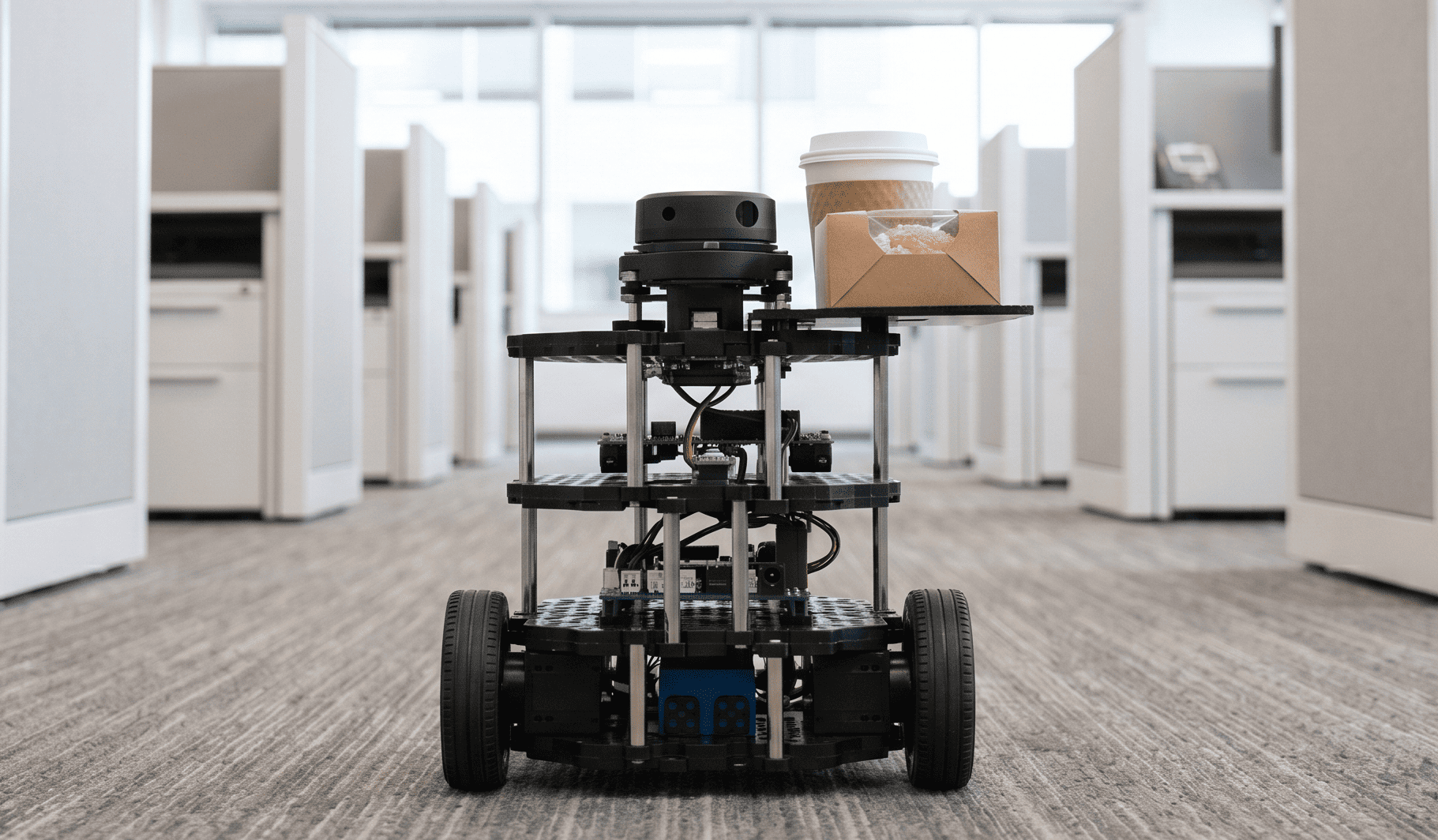
Autonomous Mobile Robot TurtleBot3 TestBed
This TestBed is a human-centred Industry 5.0 workstation for manual assembly, combining Extended Reality (XR), collaborative robotics, and neuroergonomic assessment in a single setup. It is designed for low-batch industrial assembly tasks where operators need clear instructions, intuitive human-robot interaction, and support for attention-intensive work. The setup builds on earlier ETF/ICEF work and replaces a fragmented baseline system with a more compact XR-based solution that integrates spatial assembly guidance, gaze/gesture/voice interaction, robot coordination, and mental focus assessment. The concept as a neuroergonomic workcell with EEG-based workload assessment, nonobtrusive HMI, graphical assembly guidance, a collaborative robot assistant, and an intelligent task scheduler, showing improved performance, fewer errors, and reduced mental demand. In the XR4Human-SERVE 5.0 implementation, the target use cases are assembly assistance and training assistance for real industrial products.
| Name of Principal Investigator: | Nikola Knezevic |
| Position / institutional role: | Assistant Professor |
| Info Email: | knezevic@etf.rs |
| ORCID persistent identifier (PID): | 0000-0002-0262-8956 |
| Name of Host Organization | University of Belgrade – School of Electrical Engineering (ETF) |
| Department or Lab | Department of Signals and Systems, ETF Robotics lab |
| Name of Building | Palace of Science |
| Physical Address | Kralja Milana 11, 11000 Beograd, Serbia |
| Website Links | https://robot.etf.bg.ac.rs |
| Institutional contact name | Nikola Knezevic |
| Institutional contact email | knezevic@etf.rs |
| Non-academic stakeholders |
| Industrial Partners; Startups; Professional Associations; SMEs; Community |
| Academic stakeholders |
| Undergraduate students; PhD students; MSc students; Researchers |
| Other types of stakeholders |
| Application case: | Short description: |
| Autonomous driving of TurtleBot3 with Reinforcement Learning | Implementation of Q-learning algorithm and Feedback control for the mobile robot (turtlebot3_burger) in ROS. |
| Autonomous Exploration and Mapping Using Two Mobile Robots | Two “Turtlebot 3 Burger” robots were used. Turtlebots were equipped with LIDAR sensors and odometers, which enable simultaneous localization and mapping, for which the RBPF-SLAM algorithm based on a particle filter was used. Each robot forms its own local map that is represented by an occupancy grid. Then, map merging into a common global map is performed, based on known initial positions of the robots. |
list of hardware components with their brief descriptions:
TurtleBot3 Burger, Lidar Sensor, Single Board Computer (Raspberyy Pi), OpenCR1.0
list of software components with their brief descriptions:
ROS2 Humble, Ubuntu 22.04. Python 3