


CircuBot – AI-Powered Modular Collaborative Robotic System for Object Sorting
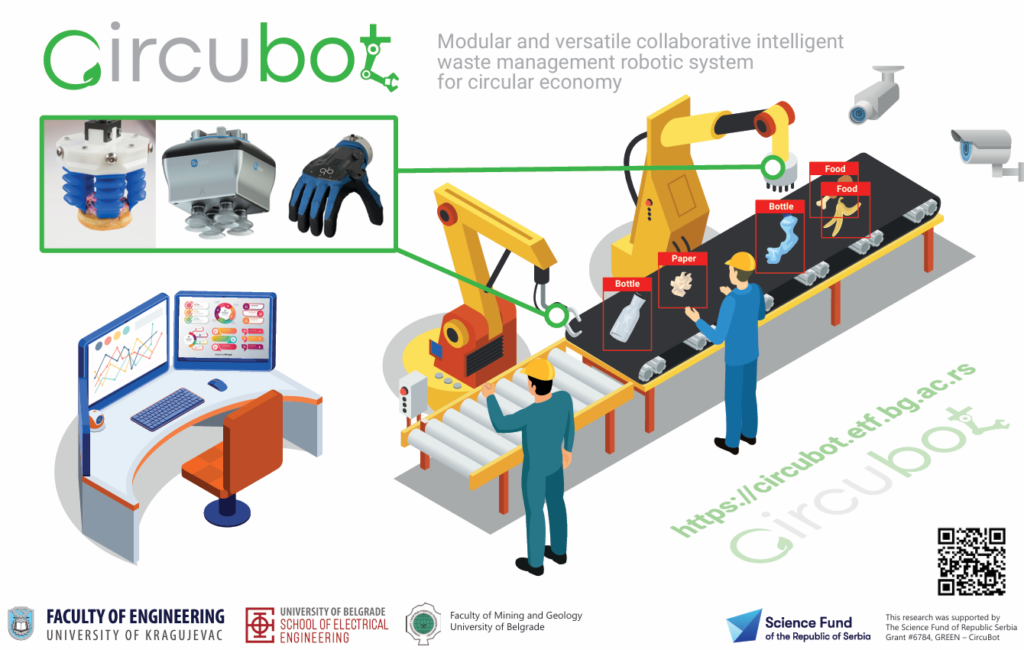
CircuBot is a modular collaborative robotics TestBed designed to support experimentation, validation, and deployment of advanced waste-sorting technologies. It integrates collaborative robots, AI-driven computer vision, soft adaptive gripping, and cloud-based data analytics to enable safe, flexible, and efficient separation of recyclable materials such as PET bottles, metal cans, and small electronic components.
The TestBed provides a controlled yet realistic industrial environment for testing circular economy solutions under real-world conditions, supporting Technology Readiness Levels (TRL) 3–8. CircuBot enables rapid Proof-of-Concept validation and performance assessment for DeepTech innovations in robotics and artificial intelligence.
Aligned with Industry 5.0 principles, CircuBot emphasizes human-centric automation, environmental sustainability, and resilient manufacturing by improving worker safety, enhancing material recovery, and enabling data-driven process optimization. Within the CITADELS framework, the TestBed offers accessible infrastructure for research organizations, SMEs, and industry stakeholders to develop and validate intelligent, sustainable automation solutions.
| Name of Host Organization | University of Belgrade – School of Electrical Engineering (ETF) |
| Department or Lab | Department of Signals and Systems, ETF Robotics lab |
| Name of Building | Palace of Science |
| Physical Address | Kralja Milana 11, 11000 Beograd, Serbia |
| Website Links | https://circubot.etf.rs |
| Institutional contact name | Prof. dr Kosta Jovanović |
| Institutional contact email | kostaj@etf.rs |
Non-academic stakeholders |
|
| Industrial Partners | Pilot deployment and validation studies of robotic sorting, handling, and collaborative operation scenarios under real industrial conditions. |
| SMEs | Testing and prototyping of robotic subsystems, perception algorithms, and circular-economy solutions with reduced development cost and risk. |
| Startups | Rapid validation of innovative robotics and AI concepts related to waste sorting, automation, and sustainability, supporting product development and market readiness. |
| Government Bodies | Evaluation of technological solutions supporting waste management strategies |
| Professional Associations | Dissemination of best practices, technical guidelines, and standards related to collaborative robotics and sustainable waste management. |
| Community | Benefiting from improved recycling infrastructure, increased efficiency of waste processing, and reduced landfill waste, contributing to environmental sustainability. |
| Others 1 (comma-separated) | Environmental NGOs, Waste management authorities, Technology transfer offices |
Academic stakeholders |
|
| Undergraduate students | Hands-on training in robotics, computer vision, and automation through laboratory exercises, project-based learning, and introductory research activities. |
| MSc students | Development and validation of advanced algorithms and system components within master theses focused on robotics, AI, and circular economy applications. |
| PhD students | Long-term experimental research on collaborative robotics, perception, control, and human–robot interaction. |
| Researchers | Experimental validation of scientific hypotheses, development of new methods, publication of research results, and participation in national and international research projects. |
| Others 2 (comma-separated) | Visiting researchers, Postdoctoral fellows, Academic collaborators |
Other types of stakeholders |
|
| Others 3 (comma-separated) | European research partners, Standardization bodies, Funding agencies |
Application case: |
Short description: |
| Automated industrial sorting (robot control & manipulation) | Fully autonomous robotic sorting of waste on a conveyor belt. AI-based vision performs real-time object detection and classification, while motion planning generates efficient pick-and-place or pick-and-toss actions using a soft robotic gripper adaptable to irregular shapes. |
| Collaborative human–robot sorting (real-time object detection & task allocation) | Shared human–robot workspace enabling safe collaboration during sorting tasks. Real-time perception and safety monitoring support dynamic task allocation, with robots handling repetitive items and humans managing complex or uncertain objects. |
| Sorting strategy design and optimization | Experimental evaluation and optimization of sorting strategies, including conveyor speed, grasping methods, and robotic cell layouts, using performance metrics such as throughput, accuracy, purity rate, and cycle time. |
| AI model training, validation, and benchmarking | Training and benchmarking of machine-learning models for waste classification under realistic conditions, including variable lighting, occlusions, cluttered scenes, and mixed-material streams. |
| Education, research, and innovation support | Use of the CircuBot testbed for student projects, academic research, professional training, and proof-of-concept demonstrations for SMEs and startups, supporting technology transfer and skill development. |