


XR Neuroergonomic Cobot-Supported Manual Assembly TestBed
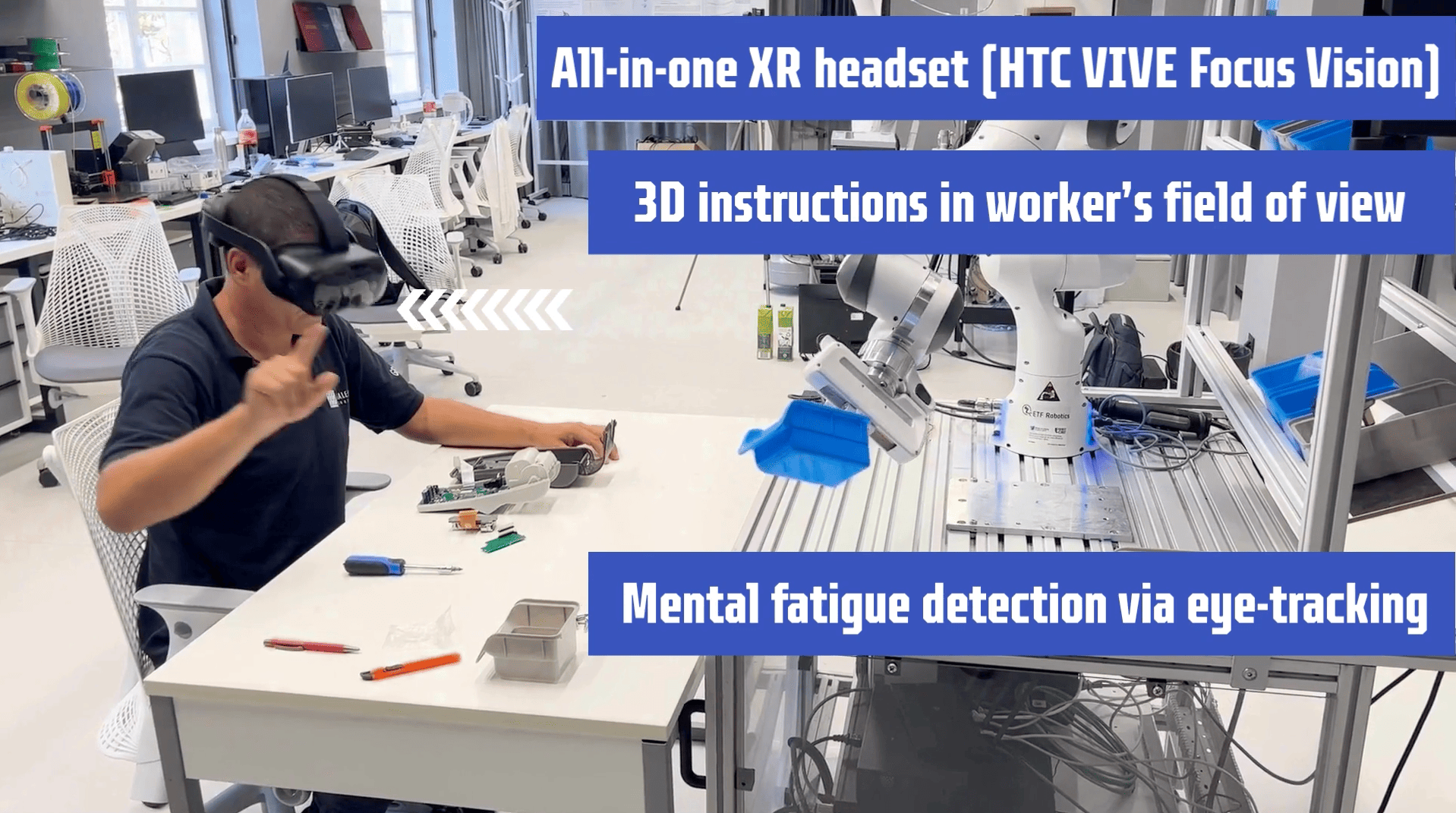
This TestBed is a human-centred Industry 5.0 workstation for manual assembly, combining Extended Reality (XR), collaborative robotics, and neuroergonomic assessment in a single setup. It is designed for low-batch industrial assembly tasks where operators need clear instructions, intuitive human-robot interaction, and support for attention-intensive work. The setup builds on earlier ETF/ICEF work and replaces a fragmented baseline system with a more compact XR-based solution that integrates spatial assembly guidance, gaze/gesture/voice interaction, robot coordination, and mental focus assessment. The concept as a neuroergonomic workcell with EEG-based workload assessment, nonobtrusive HMI, graphical assembly guidance, a collaborative robot assistant, and an intelligent task scheduler, showing improved performance, fewer errors, and reduced mental demand. In the XR4Human-SERVE 5.0 implementation, the target use cases are assembly assistance and training assistance for real industrial products.
| Name of Principal Investigator: | Nikola Knezevic |
| Position / institutional role: | Assistant Professor |
| Info Email: | knezevic@etf.rs |
| ORCID persistent identifier (PID): | 0000-0002-0262-8956 |
| Name of Host Organization | University of Belgrade – School of Electrical Engineering (ETF) |
| Department or Lab | Department of Signals and Systems, ETF Robotics lab |
| Name of Building | Palace of Science |
| Physical Address | Kralja Milana 11, 11000 Beograd, Serbia |
| Website Links | https://robot.etf.bg.ac.rs |
| Institutional contact name | Nikola Knezevic |
| Institutional contact email | knezevic@etf.rs |
| Non-academic stakeholders |
| Industrial Partners; Startups; Professional Associations; SMEs; Community |
| Academic stakeholders |
| Undergraduate students; PhD students; MSc students; Researchers |
| Other types of stakeholders |
| System integrators, Industrial trainers, Human factors / ergonomics specialists |
| Application case: | Short description: |
| XR Collaborative Assembly | The TestBed is used for real manual assembly scenarios in which the worker receives spatially aligned instructions through HoloLens 2 while the cobot delivers parts and supports the task flow. In the XR4Human-SERVE 5.0 plan, the industrial validation covers three product scenarios: GS-100, GS-200, and GP-100. Target measurable outcomes include at least 5% assembly-time improvement and at least 50% reduction in faulty parts relative to the stated baseline. |
| XR-assisted onboarding and training assistance | The same setup can be used for novice-worker onboarding and guided training, with multiple levels of instruction detail and remote assistance from more experienced workers. This use case is explicitly positioned as a way to speed up training, improve knowledge transfer, and capture where trainees need support. The target measurable outcome is at least 30% training-time reduction across the selected scenarios. |
| Neuroergonomic monitoring and fatigue-aware task support | The TestBed can be used to study operator focus, distraction, and workload during assembly by combining eye-gaze signals with workload assessment methods such as NASA TLX and, in the prior/papered setup, EEG-derived indices. In the published paper, the workstation concept is evaluated through workload, errors, task duration, and gesture accuracy, and the authors report a notable correlation between EEG workload indices and NASA scores. In the XR4Human-SERVE 5.0 plan, at least 10 participants are foreseen in industrial validation, with user feedback collected across the defined scenarios. |
list of hardware components with their brief descriptions:
HTC Vive Focuse Vision Pro, Franka Emika Panda, EEG mBrainTrain
list of software components with their brief descriptions:
XR4Human-SERVE 5.0 application stack, OpenXR,