

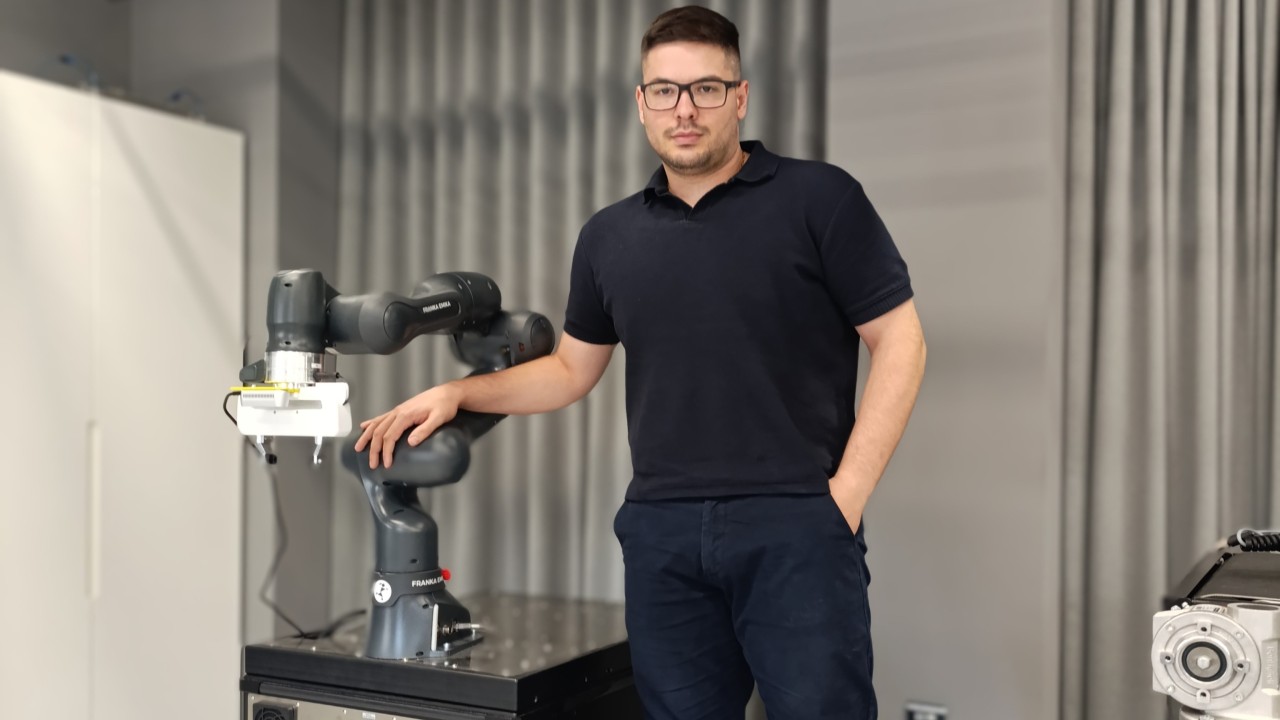
Curiosity often grows where theory meets application, and that’s exactly where Nikola Ružić’s journey began. From long hours in the ETF Robotics lab to upcoming work at the German Aerospace Center (DLR) within the euROBIN Brain Magnet Program, Nikola’s story reflects the path of a young engineer learning not only how to build better robots, but how to collaborate, adapt, and grow within a global research community. His experience shows that innovation is as much about people and shared learning as it is about algorithms and machines.
Can you briefly introduce yourself and share a bit about your interests?
In my free time, I enjoy spending time with friends along the Danube River and tinkering in my home workshop on small projects. I also like playing Club Bridge, which I find to be a great way to relax while keeping my analytical and problem-solving skills sharp.
Can you tell us about the topic of your research and what you’ve been working on at ETF Robotics?
My research focuses on advanced control methods for mobile manipulators, particularly in tasks that require safe physical interaction with the environment, such as assembly, cutting, or polishing. At ETF Robotics, we developed a state-of-the-art algorithm called Geometric Cartesian Stiffness Shaping (GCSS). This method optimizes how a robot manipulator interacts with its surroundings by adjusting its stiffness in real time, enabling both safety and precision.
Our team’s goal is to extend this approach to mobile robots, allowing the entire robot, base and manipulator combined, to perform complex tasks in unstructured environments. This work has strong applications in robotics for manufacturing, healthcare, and service industries.
What is the focus of your upcoming collaboration with DLR?
Starting in November 2025, I’ll be visiting the German Aerospace Center (DLR) as part of the euROBIN Brain Magnet program. During this visit, I’ll work closely with DLR’s Institute of Robotics and Mechatronics to extend our GCSS method by incorporating whole-body motion planning and control. The collaboration will involve simulation work, algorithm development, and validation on advanced robot platforms like Rollin’ Justin and DLR omniRob.
The ultimate objective is to develop a modular, ROS 2-compatible software stack that enables real-time stiffness shaping and safe, compliant control for mobile manipulators. This will bridge the gap between research at ETF Robotics and global robotics excellence, while creating open-source tools for the robotics community.
What are you most excited about during this visit?
I’m excited to see how our work at ETF can integrate with DLR’s advanced robotics systems. Collaborating directly with leading researchers, sharing knowledge, and seeing our methods tested on platforms like Rollin’ Justin is a unique opportunity. I believe this exchange will significantly accelerate the development of safe, intelligent mobile robots.
How has working at ETF Robotics shaped your research journey?
I have been passionate about research since my high school days and have always been fascinated by robotics systems developed and shown online. I joined the laboratory in the second semester of my final year of bachelor’s studies during a robot manipulation competition, “Robothon – The Grand Challenge”. I loved the way the mentorship worked at the laboratory, where Nikola Knezevic dedicated his time working with us one-on-one to solve difficult robot manipulation challenges, often staying after work as well.
My first task at the lab involved developing a human collision avoidance robotic system as a part of the CircuBot project. I have since been involved in two bilateral projects between Serbia, the UAE, and Italy. The HARBOT project, which we have been working on with our colleagues from Khalifa University, involves developing smart optimization algorithms for multi-robot fleets for agriculture. The AI-AGRI-HAND project, which is a collaborative effort with our colleagues at Genoa University, focuses on developing smart compliant grippers with integrated embedded platforms for Computer vision-based crop identification and classification.
I can proudly say that the work at the laboratory involves collaborating and meeting a lot of international people from different backgrounds, which furthered my scientific and social abilities. The laboratory values personal growth and research collaboration, which resulted in many conference and research visits, such as IROS 2024, hosted at Abu Dhabi, UAE, our visit to the LAAS laboratory in Toulouse, France, Optimization for Robotics Summer School 2025 at Patras, Greece, the DRIMS2 PhD Summer School 2025 hosted at the College Emiliano, Genoa, Italy, and visits to Slovenia, Hungary for precision agriculture training, along with other international trips.
Would you recommend ETF Robotics to students who are passionate about robotics?
My first contact with ETF Robotics was during my third year, when I tried developing my own 3D printed collaborative robot. I have had a problem with the servos I was using, and I have asked Professor Kosta for help. The way the laboratory had helped me solve the problem, going out their way to support a student, showed me that the laboratory is the perfect place for the start of my professional robotics journey.
Your message to future students and collaborators:
The most impactful thing on my personal development was the quality personal and professional relationships with colleagues at ETF Robotics and our international partners. I encourage passionate students and collaborators to reach out if they are interested in developing robotics and building lasting connections with our amazing team.


Comments are closed.